
Required Base Materials For Bra-making
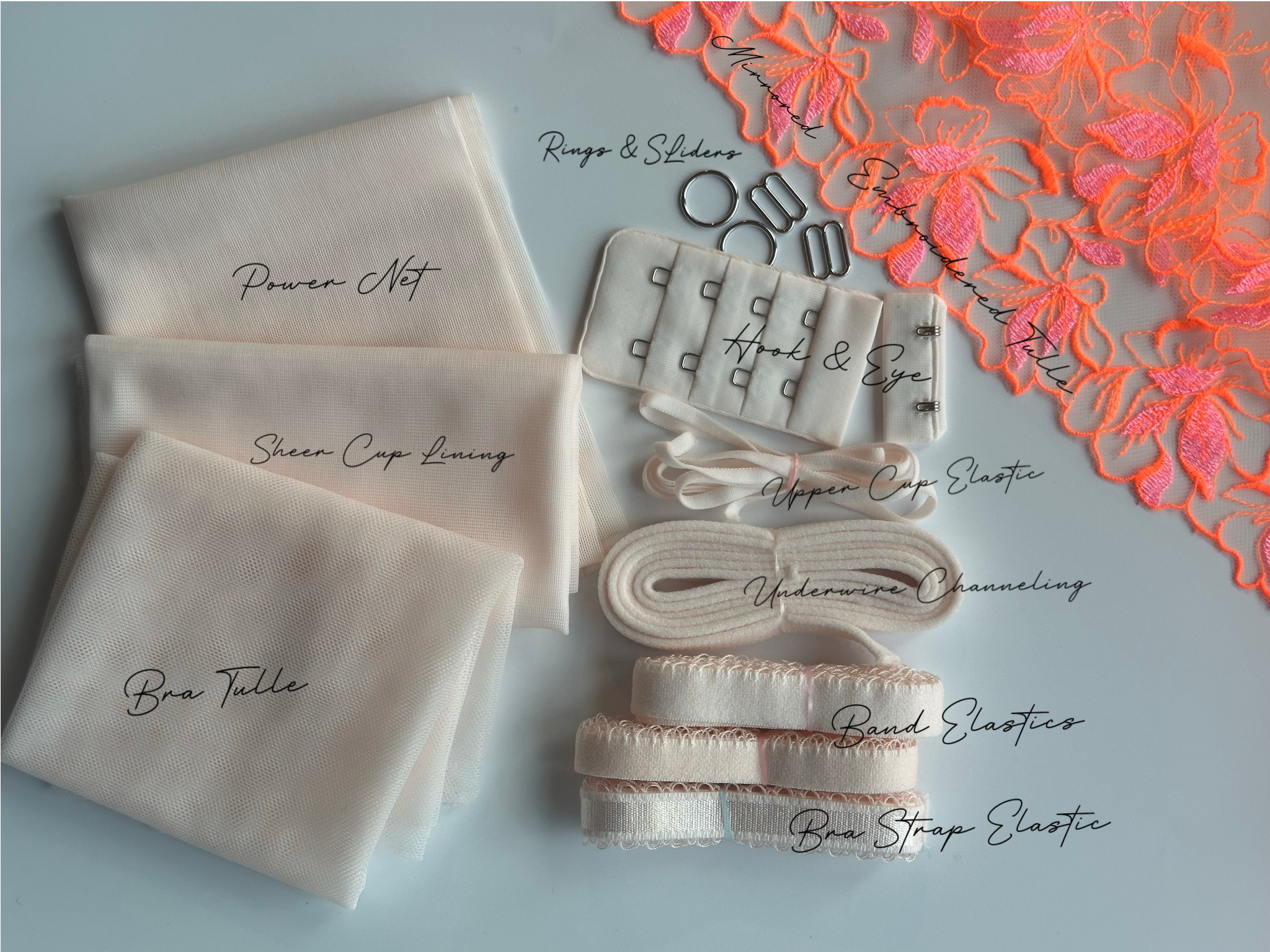
The different components of a bra
Required Base Materials for Bra Making
(or see title ideas below)
Maybe you’ve found yourself wanting to learn how to sew a bra, but quickly realized you have no idea what actually goes into one. Bras may look simple from the outside, but they rely on a carefully chosen combination of elastics, fabrics, and hardware to achieve a fully functional and beautiful piece!
In this guide, I’ll walk you through the essential base materials required to make a bra, explain why each one matters, and share tips on what to look for when sourcing high-quality supplies online.
Thread
Thread isn’t talked about nearly enough when it comes to lingerie sewing, but it’s incredibly important. Using the wrong thread can undo all the care you put into choosing beautiful fabrics and elastics.
My go-to recommendation is Gütermann Mara 120 or 150. It’s a fine polyester thread with an ultra smooth finish and shine a that works beautifully with delicate lingerie materials. Despite being very fine, it’s strong and reliable, which is exactly what you want for seams that are sewn with extremely lightweight and delicate fabrics. I purchase my threads from Wawak.com
* Helpful tip: Buy the Gütermann Thread Chart (also found on wawak.com) so that you can see all the available colors for easy color-matching your dyes and laces.
When choosing thread for lingerie, look for something lightweight with a tiny bit of mechanical stretch. Cotton thread is not recommended for stretch garments, as it has very little give and can break under pressure. Polyester, on the other hand, can handle the tension that is used in lingerie.
Elastics: The Backbone of a Bra
A well-constructed bra typically contains four different types of elastic, each serving a specific function.
1. Upper Band Elastic
This elastic runs along the upper edge of the back band, wrapping around toward the underarm area. A width of 3/8 inch is commonly recommended.
Personally, I prefer using plush elastic on both sides, especially in designs where the elastic may fold onto itself, such as when attaching a ring at the front strap. Keeping soft, plush surfaces against the skin makes a noticeable difference. This elastic typically has more stretch than the bottom elastic.
2. Upper Cup Elastic
Upper cup elastic helps seal the cup edges and stabilize the lining and outer fabric at the top of bra cups.
Many home sewists use:
Narrow panty elastic
Clear elastic
Specialty bra elastic
Widths typically range from 1/8 inch to 3/8 inch.
3. Bottom Band Elastic
This is one of the most important elastics in a bra, as it provides the majority of the support.
Bottom band elastic should be firm and supportive, not overly stretchy. A lightweight panty elastic is usually not suitable for this purpose. Most band elastics come in 1/2 inch or 5/8 inch widths.
4. Bra Strap Elastic
Strap elastic holds the cups up from the front, and keeps the band in place . The width you choose should be appropriate for the level of support needed.
Common widths range from 10mm up to 1 inch, with outliers. The larger the underbust to full bust ratio, the more beneficial a wider strap will.
Rings & Sliders
Rings and sliders should slide onto the bra strap without “squeezing” the elastic or leaving big gaps between the slider and the elastic. I recommend no more than 1mm gap between the elastic and slider.
They allow your bra straps to be adjustable.
The slider is sewn onto one end of the strap elastic
The ring is threaded through the opposite end
The elastic is then fed back through the slider, creating an adjustable loop
This simple mechanism allows the straps to be pulled tighter (making the bra fit more snug and bring the cups up).
Back Band Mesh (Power Net & Stretch Mesh)
The back band of a bra is usually made from power net or stretch mesh, and these fabrics vary significantly in weight, stretch percentage, and support level.
Most bra meshes have stretch running along the length and form small, brick-like shapes in the knit.
Here’s a general breakdown from the meshes in my shop:
240 GSM Power Net
Very firm with approximately 20% stretch. Ideal for high-support bras and anyone with a full bust.160 GSM Power Net
Medium firmness with about 40% stretch. This is my go-to mesh. This is the most commonly found mesh in RTW for standard sizes.90 GSM Stretch Mesh
Best suited for sheer panties, bralettes, or bralette cup lining with 50% stretch. While firm for its weight, it does not provide enough support for a traditional bra band by itself unless there is no support needed.90GSM Note: I like to line stretch lace bralettes with this mesh for the front and back band. With the stretch from the lace, and the mesh, it ends up being comfortably snug.
Linings & Stabilizers
Bras can be fully lined, partially lined, or completely unlined. There are many different fabrics marketed to home lingerie sewists, but i will be focusing on the fabrics carried at Stephieslingerie.com
While unlined bras can be visually stunning, they can sometimes feel irritating against the skin, especially if the lace has textured embroidery or low quality tulle. They can also be harder to finish cleanly without a serger, which is why you see many bras with linings.
Bra Tulle
Bra tulle is one of my favorite lining options for cups. Since most embroidered laces are stitched onto hexagonal tulle, I like to line cups using tulle placed in the opposite direction, which helps stabilize the cup while keeping it lightweight and breathable, and most importantly—sheer. The bra tulle in my shop is completely stable one direction, and has mechanical stretch in the other. In some designs, bra tulle can be used to line a bridge, or line the inside of a long-line bra.
Ultra Fine Bra Tulle
This bra tulle exclusive to the shop is ultra fine, lightweight, mechanical stretch in width, and slight mechanical stretch in length is very similar to some lightweight tulles you will see lingerie brands use to make embroidered tulles. This tulle is basically invisible and delicate. It makes a perfect lining for cups, luina hacks, and if you double layer it, can be used for the cradle.
Sheer Cup Lining
Inspite of the name, Sheer cup lining is typically used to stabilize the bottom front band of a bra. There is no stretch in either direction(mechanical stretch along cross-grain), making it ideal for stabilizing:
The bridge (center front)
Front bands
Decorative lace edges
Bra cups depending on personal preference
This fabric is especially useful when working with stretch lace that needs reinforcement in key areas. Sheer cup lining also comes in many qualities.. It is important to source this fabric wisely as it will be comfortably snug on your body all day.
Hook & Eye Closures
Hook and eyes are the adjustable closures at the back of the bra. Most styles feature three rows, though some may have fewer or more.
The hook and eyes offered in my shop include four rows, allowing for extra adjustability and increased longevity as the elastic naturally relaxes over time.
It’s also important to consider:
The softness of the backing fabric
The smoothness of the outer edges
Overall comfort against the skin
After all, this is something you’ll be wearing all day.
Underwire Channeling
There are many different types of underwire channeling available, and not all of them perform the same way. Some are extremely rigid, others very stretchy; some are thin and prone to fraying, while others are noticeably thicker and more structured. Most channeling shares a few common traits; typically a plush side and a small percentage of elastane.
When I source channeling for my shop, I’m very intentional about what I choose. I look for a style with a little bit of give (but not too much), usually between 3/8” and 1/2” wide, and slightly thicker in structure. Wider channeling tends to catch and anchor better into the bottom band elastic, which helps stabilize the wire and bottom cradle, preventing the bands from flipping up.
I personally avoid channeling that is overly stretchy or too thin. Excess stretch can cause the channeling to warp under heat and ruin your lingerie, and thinner constructions make it much easier for wires to work their way through. A slightly thicker channeling is more durable.
Lace
Lace is often the best part of the bra! The detail that transforms a functional garment into something truly beautiful. It’s where the design element can completely shift the mood of the entire piece.
There is no single “correct” lace for bra making. Options range from stretch lace trim, galloon lace, embroidered all over lace, all over stretch lace, rigid embroidered tulle with scallop edge, and embroidered stretch mesh.
Personally, I’m especially drawn to embroidered tulle with a scalloped edge. This type of lace can create beautiful sheer designs and utilize a scallop edge.
Why Mirrored Lace Matters
One factor that is often overlooked, but incredibly important, is whether the lace is mirrored.
Mirrored lace means the design reflects across the width of the fabric, giving you a left and right version of the motif. This is what allows you to create perfectly symmetrical bra cups, garter panels, and design features that meet perfectly at a center seam.
When lace is not mirrored, you may find yourself:
fighting to make cups match
losing visual balance across the garment
or having to compromise on placement
Anywhere your design has a center point; bra cups, bridges, garter belts, panties: mirrored lace gives a noticeably more professional result.
When sourcing lace, you’ll notice wide variation in base fabrics and embroidery styles. Some tulles feel light and sheer, while others are knit more densely in nylon. You may also see cotton eyelet, multi-directional stretch lace, diamond-shaped tulle, printed colors, loosely stitched embroideries, long satin stitches, ultra-fine threads, or more defined, dimensional motifs
My personal favorites are multi-colored floral embroideries stitched with very fine threads onto lightweight tulle. I especially love those slightly “crisp” laces, especially when paired with dainty elastics, sheer linings, and complimentary matched hardware, they create a design that feels intricate, balanced, and beautifully cohesive.